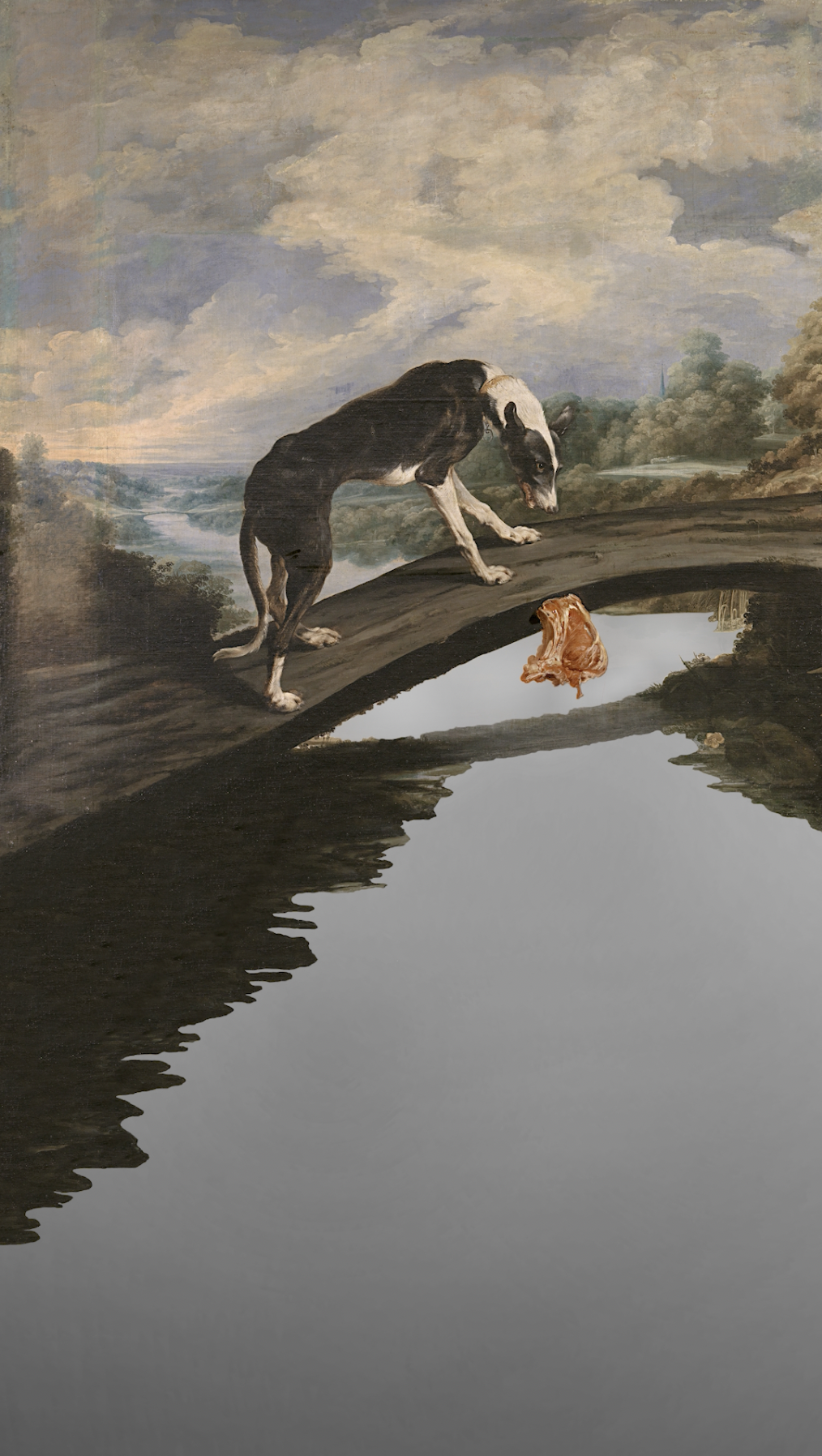
Latent Apparitions N°3, Family of Liberals tells a fictional story about two characters portrayed in a painting. The first one is a street cat, the second a domesticated hunting dog. While one is fighting for sustenance, the other enjoys abundant food given by an invisible actor, the owner.
The work playfully highlights the power dynamics portrayed in this pre-capitalist image, as well as its metaphor for privilege,
inequality and the impact of less visible actors.
These ideas of invisibility and disparity, later
in the work are critically connected to Adam
Smith’s concept in economics of the invisible
hand (XVIII) and its impact on contemporary
consumerism. According to Smith, a free
market motivated by self-interest would still
produce collective benefits.
Latent Apparitions series
Amidst worries on capitalism’s impact and failures and the question of how to react, as a maker, I started wondering how artists in Early Capitalism responded to the (then) new societal changes. This inspired the video series Latent Apparitions, where I enter into a conversation with art works from that period to reflect on current developments.
Each work takes different painting genres of the seventeenth century as a starting point, such as still life, animal scenes and landscape.
While none of these paintings have the human figure as a direct protagonist, they become actors or sceneries to tell stories of how these visual representations from the Early Modern period started capturing and shaping new ways of experiencing the world that still impact the
way we live.
For example, ways in which we relate to one another, to materiality, ambition, nature, new technologies, as well as to a sense of endless continuity and progress.